
Monday, June 29, 2020
From the viewpoint of monetary price
THINK of it another way. We know that every economic transaction has an energy component. Let's pretend that we know the correct multiplier to convert dollars to emergy units. Now let us consider the economic events that affect the price. If investors receive dividends, does that affect the price. Certainly! Does the salary paid the worker affect the price? Yes. How about the price of a tooth extraction by the worker's dentist? If it rises, eventually the worker will ask for a raise. Ultimately, it will affect the price of the solar power installation, if that's what we are talking about. Suppose the community is isolated except for net energy crossing the border. The community consumes everything else that it produces. Therefore, the entire livelihood of every member of the community must be charged to the sole producer - except for freeloaders who could be kicked out to restore the special circumstances of this thought experiment, which I thought was easy to understand. However, if understanding something compromises a man's ability to earn a living, he may have difficulty understanding it.

Thursday, May 28, 2020
Renewable Energy Profits: Energy is the life's blood of the community.
Renewable
Energy Profits
Tom
Wayburn, PhD in chemical engineering
Ferroni and
Hopkirk published an analysis of photovoltaic installations in
Northern Europe in which they reported an estimated ERoEI of 0.83,
which indicates that solar PV in Northern Europe is a net consumer of
energy. Subsequently, another analysis seems to show that their
results are extremely inaccurate and their conclusions are wrong.
This has no effect on the following which I wrote earlier:
First and
foremost: Ferroni and Hopkirk counted labor; but, they did not count
profit. There is nothing that will frak up an ERoEI* quicker
than the purveyor of solar who worked so hard to sell the damn thing
that he marked up the sale price to twice the cost to himself; and,
then, bought himself a BMW with half the profits. I have said
(more than once) that when we decide what to sell something for, we
have to include the money costs of everything that went into it.
Possibly, half the price of your fishing gear went into profits.
And ... those retailers of fun didn't sit on their profits; they
spent them; and, there was an energy consequence for each purchase or
sale. That's why the Total Energy Budget (E) tracks the
GDP so well that it can be characterized by a single number:
E/GDP, tabulated for each year for every country (nearly) in
the world. (By the way, I don't think they (the DOE) make
it quite so accessible as they once did.)
Second, you know
how they always say, "And, it will create X number of new jobs,"
not noticing that that counts against the entrepreneur's renewable
energy brainstorm. And, if he is hiring highly-paid managers,
the ERoEI plummets.
Now, the ERoEI*
can be raised by a number of tactics most of which sound like
degrowth, decentralization, dechrematisticalism, and dematerialism.
I noticed early on that most working people do NOT make anything we
need or want or do anything that is useful to the community.
They work hard; but, if they are “successful”, the net result is
more money for themselves or for their employers and not much else.
In "Energy in a
Natural Economy", I computed that we could do things
for about one-third the energy we now spend if we cut out the money
game. (This is true trivially for the healthcare sector,
which ought to be more amenable to make the change, as they are not
supposed to need that change.) I didn't even begin to assess
secondary effects; e. g., much less business activity means fewer
copying machines etc. that businesses use and manufacturers use in
the business end of the business.
Decentralization
is key in the delivery of electricity to its ultimate use, which
ought to be very close to where it is produced. On the other
hand, the capitalist mode of production involves large percentage
line losses not to mention the energy costs of building and
maintaining the gargantuan infrastructure of distribution.
If the production is sufficiently decentralized (say, that each user
has his own production facility), each producer can be his own
maintenance man and his own operator. One more thing: not so
much decentralization as abandonment of the capitalist mode of
production, which, as you know, demands continuous operation as
opposed to batch mode. You know how they say, "It's no good
because it is not dependable." "0. K.," says me,
"when the sun don't shine, go to bed."
Another benefit
of decentralization is the simplicity with which one can clean the
solar collectors to maintain a high effectiveness ratio, the fraction
of incident availability that is passed on to be recovered.
Let's consider a
couple of experiments that would go a long way toward settling these
long-standing debates. (i) Milton Maciel was a member of Energy
Resources. He is a chemical engineer with a PhD, I believe.
He once was a deputy energy minister for Brazil in which country he
operated a large plantation which was nearly self-supporting in a
true isolated manner except for a few details that we might easily
have fixed for the purpose of producing a close approximation to the
autonomous alternative energy district - except for mining,
where - fortunately - there is pretty good data on the emergies of
the sorts of thing that Milton would have been needing for this
experiment - assuming he would have a machine shop and a full-time
machinist and two apprentices on the premises. Everyone who
worked there lived there. We would certainly get a good
idea whether we had an ERoEI* greater than 1.0 or less than 1.0, I
think. (ii) Something nearly as good could be done with a large
manufacturing plant that is capable of a reduced number of links to
the outside and a small number of similar but complementary
facilities; so, the input/output matrices are quite small and few in
number. Now, if these could be run on dematerialist principles,
that would be fantastic for showing what I have come to depend on
after years of computations, namely, that one can devise a political
economy that will function and survive on a finite Earth whereas
market system economies that permit chrematistics
will not.
Remember, that
the result of all these retractions (decentralization, degrowth,
dematerialism, and dechrematisticalism) is that, for the most part,
the purveyors of the technologies will be those who are the principal
benefactors.
I still think
ERoEI is a great tool and the detractors are people who can't get
their heads around it. Again - for the most part.
I
just re-read Euan Mearns' excellent piece, “ERoEI for Beginners”,
in his Energy Matters blog. Toward the end of the article, he takes a
stab at dividing human activities into some that we can charge to the
effort of producing energy and others that we must list as consumers
of the energy produced. Here is a sample of the things people say
that reveal a limited understanding of how ERoEI should be
implemented: “Net energy is the surplus energy left over from our
energy gathering activities that is used to power society – build
hospitals, schools, aircraft carriers and to grow food.”
Please note that, depending upon circumstances, all four –
hospitals, schools, aircraft carriers, and food – belong in EI. If
there is anyone who is not a part of the energy mission, pro-rata
charges would be introduced.
You
see, Euan thinks like an economist. He thinks of energy as a
commodity – like house paint or pork bellies – that we wish to
utilize for our comfort and convenience. Energy is not just something
we use as part of our lifestyle. We should not think of it as just
one thing – but, rather, as everything,
like breath and blood combined. It is
life.
Any member of the community for whom it can be said that this person
does nothing for the flow of energy, is wasting energy. He should be
furloughed; and, he should be happy to do whatever his intrinsic
interests dictate, which has been the object of acquiring an
education. If the Matching Problem of Chapter 2 of On
the Preservation of Species
has
been solved, we will be able to determine feasibility or
quasi-sustainability or sustainability immediately. I must finish
updating Chapter 2 of On
the Preservation of Species
or
write a stand-alone description of the Matching Problem. Earlier
today, I read the following:
Note.
Permit me to define two, perhaps new, meanings of the words "profane"
and "transcendent". Let us consider an act of
man profane if its purpose is to provide for life
the energy that supports life all of which comes ultimately from
Nature, e. g., agriculture. Let us consider an act of man
transcendent if its purpose can be said to be to
build a monument to God whether God exists or not, e. g., art.
Let us consider all other acts of man to be "frivolous".
Then, one can choose to place the energy costs, EP,
of all profane acts in the Energy Invested (EI). One can
include the energy costs, ET, of transcendent
activity in EI if the transcendent be considered necessary to the
profane. One can include the energy costs, EF, of
frivolous activity provided we associate an efficiency to EI equal to
[EP + ET]/[ EP + ET + EF]
at which point we have arrived at the balance equation approach to
feasibility because the ER/EI will be exactly 1.0 for a real society
running on the energy technology under investigation.
This was written
by me a sufficiently long time ago that I did not recognize the
writing nor the mood of the author at the time of the writing, even
though he was myself. It seems I had already begun to think of all
efforts to support life as directly or indirectly producing energy.
It is as though energy is life. It reminds me of the way in
which we state that we are still alive by means of such figures as
“I'm still breathing” and “My heart still beats.” Whether I
thought that then and still think it or not, I intend to cease to try
to separate my profane activities into energy and non-energy parts.
Moreover, I think the transcendent is necessary to the profane.
Although, it hurts me to admit it, there are many people who do not
consider Elvis Presley's music frivolous. In fact, a few people
consider it transcendent. Indeed, I don't think this sort of
economic triage is likely to succeed; therefore, let me propose the
following rule: Charge all activity to energy invested. I shall want
to test this proposal in a number of ways before I send this page to
anyone. Here is what another one of our colleagues said:
1) We found by
"following the money" and assigning (a probably
conservative) energy intensity factor to each Euro spent to generate
and run a one GW plant in Spain that only about one third of the
energy required to deliver electricity to the bussbar is used
for the panels. Our estimated EROI was only about 2.8 :1, or
7:1 if you want to include a quality factor for output. (Prieto
and Hall 2012 Spain's photovoltaic revolution Springer).
2) You don't need
a bare energy net profit (and a large base), but a fairly
robust one, which we estimate (imperfectly) as 3:1 to drive a vehicle
to something from 5:1 to 12:1 for our modern society ; See the
first two attached papers . Otherwise your whole economy is
just (barely) getting energy but not doing anything with it.
3) including some
way of compensation for intermittency greatly lowers the EROI. See
papers by Graham Palmer on this.
4)
The transition to renewables (desirable for me too) would require
enormous investments up front, almost inevitably of fossil fuels,
possibly lowering EROIs to critical values. The paper by
Capellan-Perez is crucial.
I will comment on
the above four items here:
- Since the delivery plays such an important role in determining the operational costs, we can expect a large increase in ERoEI* if we live and operate our solar energy facility so close to the point of use that the delivery costs are nil.
- Great pains are taken to compute EROI after which all the accuracy is discarded by pulling an integer out of the air. “Otherwise your whole economy is just (barely) getting energy but not doing anything with it.” This reveals once again that the speaker is thinking of an economy made up of an energy sector serving the rest of the economy; but, in a crisis, every member of the community should be a part of the energy sector and, therefore, his entire energy budget goes into EI*. Actually, even in normal times, the principal business of the economy is to keep the energy flowing, after which food can be provided fairly easily. We make sure we have blood circulating; but, we don't ask it to do something for us outside of our bodies.
- If the capitalist mode of production is to be abandoned, there is nothing preventing owner-operators restricting themselves to small batch jobs, with only enough stored electricity on hand to finish a small batch. In the next paragraph, we estimate the new ERoEI very roughly; and, the conclusion should be taken with a grain of salt. As for storage, we have 3D printing, CnC, and other robotics, that can store electricity as emergy.
- I will read Capellan-Perez next; but, for a lark, multiply 0.8 by three to account for the savings in delivery costs. Then, multiply 2.4 by three to account for furloughing workers engaged in chrematistics. This gives us ERoEI* = 7.2 or Net Energy = 6.2 with which to support dead heads. Inasmuch as the chief benefactor is the purveyor, he doesn't need to make a profit nor hire expensive help. In fact, we can manufacture half of the installation “down on the farm”. Maintenance is straight DIY. We are subsistence roughnecks not commodity twits. No bankers need apply. It may be easier to go along with those of us who wish to Power Down to Earth as a Garden than to preserve The Empire. Population shrinkage and economic shrinkage are necessary.
Finally, we need to show, with a simple thought
experiment, that profits should be added to EI*; that is, profits are
interior to the AAED,
Suppose we have the economically (and energetically) isolated
Autonomous Alternative Energy District in place except that the sole
stockholder wishes to take his large profit outside of the District
and spend it as part of the general public. Convert the profit into
energy product equivalents. Should the energy accountant add these
energy equivalents to the Energy Invested or the Net Energy?
Normally, the energy represented by the energy equivalents doesn't
exist yet. If it were part of the net product (assuming that the
process generates net product, that is, ERoEI* > 1.0), it could
remain outside the district, but the stockholder would have to be
reimbersed. Suppose the stockholder uses energy equivalents to buy an
expensive car. The merchant will turn up at the AAED to redeem his
certificates or whatever token he has been given. We still do not
know that there will be any net product, But, are the profits
investment or are they product? When the AAED has Net Product
available for export, it ships it to the purchaser who compensates
the AAED in a currency completely independent of the AAED accounting
system. But, product equivalents paid to a stockholder do not
fit this pattern.
(I have neglected the sunlight falling on the district and the infrared junk heat radiating to deep space; but, the first is free and the second is worthless.)
This idea that “the entire community must think of
its mission as keeping the energy flowing” can be taken to the
limit. The only members of the community who should not be considered
part of the energy sector are the unemployed. This is a new idea for
me and I would like to devise a compelling thought experiment if not
a proof. I'm afraid I shall be relatively lonely with my new insight
that may assist me in reinforcing my conception if it is not leading
me down the primrose path. I remain, however, a fallibilist.
To begin, I should like to show the connection to
energy production for any employed person in any community in which
an alternative energy is able to supply the entire energy budget
regardless of whether or not it becomes necessary from time to time
to “borrow” energy from the outside. We say “borrow” because
we expect to pay back in our alternative energy, where all
kilowatt-hours of single-phase, 60 Hz, 120 Volt AC are equivalent. Every employed person in a community that has not furloughed chrematists will have to be considered useful to the people who do useful work, since they tolerate him. So
step right up. Take a card. Any card ...
Monday, January 20, 2020
A Review of the Considerations that Determine a Choice of Political Economy
Sustainability
Sustainability is the first consideration in choosing a political economy. It is this alone that disqualifies capitalism and other market systems. We have shown that market systems require economic growth, whereas what is needed in the United States is market shrinkage or degrowth initially until whatever sized economy is taken to be optimal is reached after which a steady-state economy seems to be most desirable. To accommodate a few people who imagine that an economy can grow in perpetuity without encountering intolerable scarcity and other undesirable conditions it is necessary to prove that this is impossible.
The Defects of Capitalism: My List
Thus,
we see that I was attracted to the moral basis of dematerialism; and,
in the beginning, I did not realize that dematerialism might be
sustainable whereas other political systems were not.
Axiomatic Morality
There
is nothing either good or bad, but thinking makes it so. –
Shakespearce's Hamlet
Nietzsche
came to this sentiment rather late in the day and Mary Baker Eddy
gave it second place on her Frontispiece in Science
and Health; but,
the authorities are not needed, as one can verify the truth of it
with a little reflection. However, when I began writing On
the Preservation of Species, I
was not the devout atheist I have become. I was still an agnostic but
an agnostic with a decidedly Christian bias. I did not notice the
Christian bias even as I was writing disparaging papers to convince
someone, undoubtedly myself, that Christianity could not be true –
even though “On
the Separation of Church and State and the Case Against Christianity
and Other Improper Religions” began as a multipart serial piece
in The Truthseeker until after two or three installments the
editorial staff realized I was anti-Capitalist as well as
anti-Christian and shut me down. Nevertheless, statements like “Human
nature is inherently good and generous. The evil deeds done by
humans come from the defects in society” betray my heretical
Christian bias and the idea that I could distinguish “good” and
“evil”, despite Church doctine. Thus, at that time, I may have
been an agnostic; but, I was a Christian agnostic
on his way to becoming a Christian atheist, as strange
as that sounds.
Let us say that I am beginning to overcome my Christian bias with
great difficulty. I doubt that I shall ever come to despise or
disparage The Sermon on the Mount.
Pronouncements
of moral judgments are termed “normative”. Laws, then, are
made for the convenience of the community and to discourage
nuisances. In my philosophy, I ask that they be few in number,
readily derivable from a minimal set, and satisfy the three criteria:
reasonableness, utility, and beauty as discussed ad
infinitum.in.Chapter
3.of.On
the Preservation of Species. The
not-quite-independent set of minimal principles to which I subscribe
can be rendered in slang as follows: (1) live and let live, (2) tell
the truth to those who have a right to know it (Hemingway, Green
Hills of Africa), and (3) protect the environment. These and
their corollaries deserve a great deal of elucidation and they get it
in Chapter 3 (above) and throughout my papers and book. For example,
I have tried very hard to show that precept number one demands
economic equality.
One
if the reasons for the necessity of economic growth given by Delaney
was the need for workers to expect to be better off in successive
years despite the rich growing richer. This cannot be true if the
economy can no longer grow. After the limit to growth has been
reached economic equality is necessary to achieve the stability
previously achieved by growth. In particular, when unlimited
acquisition is possible, the superior players of Money Games will end
up with practically all of the money as in the popular game of
Monopoly in which one player ends up with everything. Then, we shall
have returned to Feudalism, which we didn't like when we had it. In
this fashion the Economic Equality Corollary to the Freedom Axiom is
validated. It is the moral choice because its omission is
inconvenient – to say the least.
Finally,
I believe we should avail ourselves of well-defined physical
quantities as much as possible in stating the requirements of the
law. In cases, where no judgment can be made based on first
principles, we should defer to equality, e. g., the division of
residential property or shares in the sustainable social dividend
(the net production of useful goods and services by
the community).
Dematerialism Satisfies Moral Requirements and Is Sustainable
Thus,
dematerialism satisfies moral imperatives that we might adopt because
of an inspired reading of the Sermon on the Mount, a clear appraisal
of the needs of the community, and an understanding of what
convenience amounts to for an entire community. I, for my part,1 test
every public policy against the three criterea discussed in Chapter 3
Toward Axiomatic Morality of On the Preservation of
Species, namely, reasonableness, utility, and beauty.
Nevertheless, every political economy upon which we hope to build a
lasting civilization must a fortiori be sustainable.
Tuesday, November 19, 2019
The first characteristic of the natural economy described by me is a give-away economy. I think I can state that with a trifle more precision:
- Probably, the community will have to monitor the extent of each economic actor’s consumption of (i) fresh water, (ii) land, (iii) contributed human labor in excess of what is done by economic actors to further their own private interests, and (iv) the emergy of manufactured objects. This will be necessary until a generation of citizens is born that recognizes the importance of minimizing consumption. Thus, the economy is consumer-planned subject only to the consumer’s responsibility (a) to use no more than 1/Nth of the sustainable fresh water, 1/Nth of the land that has not been set aside as part of the commons or is otherwise inviolable, and 1/Nth of the hours of human labor contributed to the common pool by people who have done more labor than what they require for their private interests, such as their households, and 1/Nth of the sustainable production of manufactured items (measured in emergy units) where N is the number of consumers and (b) to reproduce himself or herself only, to pass on his reproductive rights to another, or not to reproduce. Probably violators will have to be sterilized (painlessly) along with the excess child. This policy will be resisted rather vigorously, I suppose, and for good reason, but what else can be done?
- Local economic enterprises owned by workers in the sense of custodianship. Decisions are made by direct vote – one worker, one vote. It is important that worker ownership not extend beyond the premises of the plant where the work is done. Decentralization not incorporation. Each enterprise integrates the plans of its consumers into a total economic plan for the enterprise and notifies its suppliers accordingly. This must be achieved with negligible energy costs, probably with a computer. The economic actor might organize his or her personal emergy budget well in advance, also with a computer.
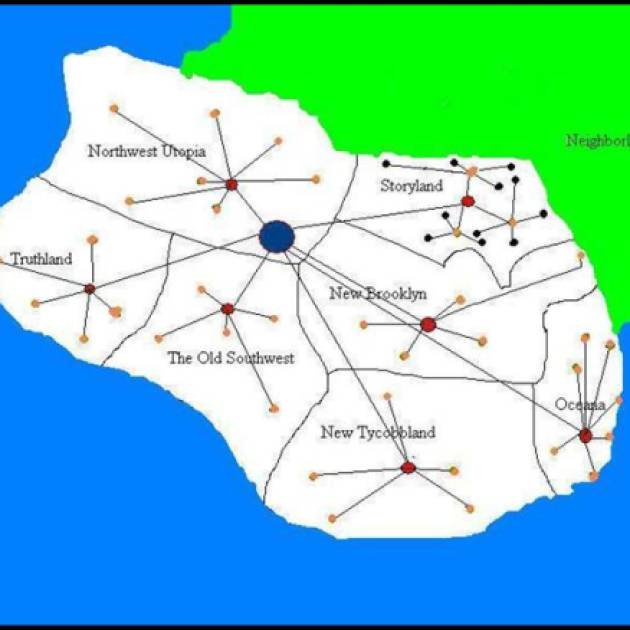
- Public servants chosen quasi-randomly, somewhat as jurors are chosen2, for limited terms that cannot be followed by another such appointment. Recall is by direct vote of all members of the community whom I call citizens for lack of a better term. The term fractal government denotes a system of small communities wherein every citizen belongs to a local parliament that is tied in a loose federation with other such communities in similar parliaments that are tied in loose federations to other parliaments of parliaments.This is similar to fractal structures, except that a loose federation of the world can have only a finite number of sub-levels, as does every representation of a fractal in the real world. Among a very small number of public servants are the members of local communities who sit in the parliaments that determine public policy for the community’s eco-region, which randomly selects members of itself who make policy for a collection of eco-regions. And so on. Every one of these “members of parliament” is subject to immediate recall by the direct vote of the body that chose him or her. Thus, the only permanent members of the government are the people themselves who share political power at the community level in the sense of one-person-one-vote. Naturally, some people will have more influence than others if they are widely respected; but, they cannot convert this influence to greater wealth. Ultimately, this arrangement should evolve into no government at all.
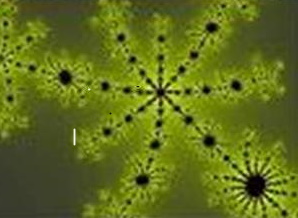
Figure 1. Fractal
Figure 2. Fractal Political Structure
- The Fundamental Principle of Neighborliness in dealing with neighboring communities, so that the dependence of economic well-being on geography is minimized. (Wealth flows always from richer communities to poorer communities or not at all.)
- Defense by citizen militias if necessary. The decision to bear arms is up to the citizens.
- It is recognized that the federal government is likely to suppress any effort to form an intentional community (or reform an existing community) along egalitarian lines, i. e., with a Natural Economy, unless collapse has already commenced, in which case the federal government will no longer be able to function because the most powerful people in government will have given up in despair and will be trying to save themselves – at least Dmitry Orlov has made a good case for this in “Closing the Collapse Gap”, which compares the collapse of the Soviet Empire with the very likely collapse of the United States American Empire.
Tuesday, October 23, 2018
The World According to The Dematerialist
We have established to our own satisfaction that the world is at or near the limits to economic growth. (To convince denialists, it might be convenient to show that some of the essentiial components of economic growth entail the extraction of increasing quantities of natural resources and the degradation of increasing quantities of energy corrected by entropy, that is, thermodynamic availability.) American-style capitalism entails (i) the development of technological advances that displace workers for whom new jobs must be found, (ii) economic inequality that will be tolerated only under a rising standard of living for the work force, (iii) fractional reserve banking, and (iv) a stock market. All of these require perpetual economic growth. Thus, American-style capitalism cannot be sustained. Inasmuch as it is unlikely that it will be replaced in an orderly fashion, we must wait for its collapse remembering that "evil's death is sure - but slow". In the meantime, we must attempt to increase awareness of the possibilities for new systems. We must begin now to solve the problems associated with every possible social system. I hope to present my vision of the Earth as a Garden with a Natural Political Economy as discussed in these pages, at https://www.dematerialism.net/, in the papers linked to that site, and in my large book On the Preservation of Species, which I had better get busy redacting.
Tuesday, May 20, 2014
Sustainable Land Use
I would like to thank Azniv Petrosyan for suggesting the use of remote imaging to assess land use, in particular to assess bio-diversity in wilderness areas. Other than that I do not see how her paper “A Model for Incorporated Measurement of Sustainable Development Comprising Remote Sensing Data and Using the Concept of Biodiversity” can be at all helpful. In particular, although it mentions population, it does not seem to recognize that the population must be shrinking or steady at its optimum in any sustainable community. Most important of all, the paper does not recognize the limits to growth nor does it insist upon a closed energy balance that does not consume fossil fuels. It is unlikely that research in sustainability that does not somehow depend upon Howard Odum’s beginnings can be relevant. But, then, I do not expect any help in our present dire crisis from the employees of universities, corporations, governments, or private labs – except insofar as they violate the bounds of their employment, which sometimes happens. It’s unfortunate that most of us must find a way to make a living. Not many scientists will thank me if I tell them that they should earn it in some other way than from science and that they should do science unfettered by the restraints of their employment. At the risk of being labelled an elitist, I must point out that many giants in the age of giants were independently wealthy or employed outside science.
Now here is the new thinking that Azniv’s paper inspired: Let us divide all land use into (1) wilderness, (2) park-like areas, (3) garden-like areas, (4) residential, (5) agricultural, and (6) industrial areas.
1. Wilderness Area: This must be growing and bio-diversity should not be diminished.
2. Park-like areas: These may grow at the expense of all other areas except garden-like areas and wilderness. They constitute the most important scenic outlooks and recreational areas such as beaches where there can be vigorous (but not destructive) human behavior (hiking, swimming, camping, fishing, perhaps even hunting – but not the use of off-road vehicles). Ideally, wild and domestic animals might have free access to parks depending upon mutual tolerance.
3. Garden-like areas that are cultivated but where vigorous human activity and, of course, industrial activity including agricultural is excluded. I have extolled the notion of Earth as a Garden in my earlier writing and I still like the concept. Humans may enter such areas but only gardeners may interact with it. The growth or maintenance of such areas should be similar to park-like areas. A certain amount of food should come from gardens; but, it must not be “farmed” with heavy equipment.
4. Residential areas should be shrinking or less populous but not growing. They may have an index associated with them that accounts for gardens and parks within them.
5. Agricultural area adjusted for partial or intermittent use should be steady or shrinking and should employ sustainable methods. I do not know much about permaculture; I must assume that it is truly sustainable. Further, I assume that no fossil fuel is employed.
6. Industrial areas – even after adjustments for the areas required to harvest sunlight and prevent pollution must not be growing.
Although I have not discussed mixed use areas, I have said enough for now – considering that these ideas originated only an hour or two ago. Let me sleep on this. In the meantime, I hope to hear from others.
I should have been back here editing this entry the daay after it was posted, that is, just as soon as I realized that I did not list urban areas separately. Clearly, we shall have cities for yet a little while longer, although they should shrink until the last vestiges of commerce and finance have vanished. Cities should be centers of art and entertainment.
7. Urban areas should be shrinking rapidly for quite awhile. Let us say that they are changing to mixed use, as it is difficult to compactify urban sprawl.
Now here is the new thinking that Azniv’s paper inspired: Let us divide all land use into (1) wilderness, (2) park-like areas, (3) garden-like areas, (4) residential, (5) agricultural, and (6) industrial areas.
1. Wilderness Area: This must be growing and bio-diversity should not be diminished.
2. Park-like areas: These may grow at the expense of all other areas except garden-like areas and wilderness. They constitute the most important scenic outlooks and recreational areas such as beaches where there can be vigorous (but not destructive) human behavior (hiking, swimming, camping, fishing, perhaps even hunting – but not the use of off-road vehicles). Ideally, wild and domestic animals might have free access to parks depending upon mutual tolerance.
3. Garden-like areas that are cultivated but where vigorous human activity and, of course, industrial activity including agricultural is excluded. I have extolled the notion of Earth as a Garden in my earlier writing and I still like the concept. Humans may enter such areas but only gardeners may interact with it. The growth or maintenance of such areas should be similar to park-like areas. A certain amount of food should come from gardens; but, it must not be “farmed” with heavy equipment.
4. Residential areas should be shrinking or less populous but not growing. They may have an index associated with them that accounts for gardens and parks within them.
5. Agricultural area adjusted for partial or intermittent use should be steady or shrinking and should employ sustainable methods. I do not know much about permaculture; I must assume that it is truly sustainable. Further, I assume that no fossil fuel is employed.
6. Industrial areas – even after adjustments for the areas required to harvest sunlight and prevent pollution must not be growing.
Although I have not discussed mixed use areas, I have said enough for now – considering that these ideas originated only an hour or two ago. Let me sleep on this. In the meantime, I hope to hear from others.
I should have been back here editing this entry the daay after it was posted, that is, just as soon as I realized that I did not list urban areas separately. Clearly, we shall have cities for yet a little while longer, although they should shrink until the last vestiges of commerce and finance have vanished. Cities should be centers of art and entertainment.
7. Urban areas should be shrinking rapidly for quite awhile. Let us say that they are changing to mixed use, as it is difficult to compactify urban sprawl.
Monday, April 21, 2014
A Discussion of Planned Economies that Began on the Google Group America 2.0
1. What I mean by a
planned economy
I'm afraid I should not have referred to my version of a natural economy as a "planned economy". Perhaps, the term "decentralized privately planned economy" almost tells the story, except what I mean by "privately" is a little odd. I believe I have constructed a sort of syndicalism. Regrettably, though, I have not looked at the definition of every type of non-market economy. The only role for government in this sort of natural economy is to administer the rule that each consumer use no more than 1/Nth of the total sustainable dividend of the economy (measured in emergy units) where N is the number of consumers and reproduce himself only, pass on his reproductive rights to another, or not reproduce.
Ethan Nagler at America 2.0 wrote:
Ethan Nagler at America 2.0 wrote:
Just read up a little on the "calculation problem" defined by the Austrian
economists. As far as I understand it, their argument is not dependent on
their flawed conceptions of human nature.
It's impossible for a small number of people, no matter how intelligent, to
calculate, without price, the wants/needs/desires of millions of people
across vast distances. That's why planned economies always end up in
famine. Until you can prove that you have an algorithm for calculating
everyone's needs 100% of the time, then any other arguments for a planned
economy are futile, in my opinion.
My answer:
I believe the Austrian economists are right; but, their result
does not apply to my version of the natural economy:
A Natural Political Economy
In Chapter 5 of On the
Preservation of Species, Wayburn describes a society that has abandoned
materialism, that is, a society in which Dematerialism has already taken place.
This might be tested in an intentional community despite the obstacles
presented by the materialistic society in which it is embedded or throughout
which it is distributed. The community would have the following features:
1. A
give-away economy with no monetary system[1]. Each economic
actor[2] notifies directly the enterprises that supply his genuine
needs, which, in turn, tell him when the item or items can be picked up or will
be delivered depending upon which mode has the lower emergy costs. Clearly, delivery syndicates
will need to minimize emergy by solving optimization problems – possibly of
combinatorial complexity – by computer, if computers are available in the wake
of Peak Oil. Otherwise, emergy consumption is not likely to be minimized,
although it may be acceptably low. Being too poor to afford a computer
for each economic actor is another case of the poor communities getting poorer;
but, even in the worst case, it will not be accompanied by the rich getting richer
to exacerbate the situation. These enterprises also report the emergy
values of the item or items to each economic actor and to a public servant if
the community deems this necessary until people have learned the lesson of
minimizing their consumption. Thus, the economy is consumer-planned
subject only to the consumer's responsibility (a) to use no more than 1/Nth of
the total sustainable dividend of the economy (measured in emergy
units) where N is the number of consumers and (b) to reproduce
himself only, to pass on his reproductive rights to another, or not to
reproduce. Life can be made discouragingly difficult for cheaters.
Note 10.25.2018: An economy that can afford to have consumers take what they need might be instituted when the notion of restrained consumption and sustainability is well understood and universally accepted, that is, ingrained. There is no need to go into details of the distribution process other that to say that consumers should deal directly with producers. It is not such a great compromise to provide all economic actors with a sort of debit card linked to land, fresh water, emergy, and human effort upon which they can draw up to 1/Nth of the sustainable supply.
Note 10.25.2018: An economy that can afford to have consumers take what they need might be instituted when the notion of restrained consumption and sustainability is well understood and universally accepted, that is, ingrained. There is no need to go into details of the distribution process other that to say that consumers should deal directly with producers. It is not such a great compromise to provide all economic actors with a sort of debit card linked to land, fresh water, emergy, and human effort upon which they can draw up to 1/Nth of the sustainable supply.
2. Local economic enterprises owned by
workers in the sense of custodianship. Decisions are made by direct vote
– one worker, one vote. It is important that worker ownership not extend
beyond the premises of the plant where the work is done. Decentralization
not incorporation. Each enterprise integrates the plans of its consumers
into a total economic plan for the enterprise and notifies its suppliers
accordingly. This must be achieved with negligible energy costs, probably
with a computer. The economic actor might organize his or her personal
emergy budget well in advance, also with a computer.
3. Public
servants chosen quasi-randomly, somewhat as jurors are chosen, for limited
terms that cannot be followed by another such appointment. Recall is by
direct vote of all members of the community whom I call citizens for lack of a
better term. The term fractal government denotes a system of small
communities wherein every citizen belongs to a local parliament that is tied in
a loose federation with other such communities in similar parliaments that are
tied in loose federations to other parliaments of parliaments. This is
similar to fractal structures, except that a loose federation of the world can
have only a finite number of sub-levels, as does every representation of a
fractal in the real world. Among a very small number of public servants
are the members of local communities who sit in the parliaments that determine
public policy for the community’s eco-region, which randomly selects members of
itself who make policy for a collection of eco-regions. And so on.
Every one of these “members of parliament” is subject to immediate recall by
the direct vote of the body that chose him or her. Thus, the only
permanent members of the government are the people themselves who share
political power at the community level in the sense of
one-person-one-vote. Naturally, some people will have more influence than
others if they are widely respected; but, they cannot convert this influence to
greater wealth. Ultimately, this arrangement should evolve into no government at all.
 |
| Figure 1. Fractal |
 |
| Figure 2. Fractal Political Structure |
4. The Fundamental Principle of
Neighborliness in dealing with neighboring communities, so that the dependence
of economic well-being on geography is minimized. (Wealth flows always
from richer communities to poorer communities or not at all.)
5. Defense by citizen militias if necessary.
The decision to bear arms is up to the citizens.
6. It is recognized that the federal
government is likely to suppress any effort to form an intentional community
(or reform an existing community) along egalitarian lines, i. e., with a
Natural Economy, unless collapse has already commenced, in which case the
federal government will no longer be able to function because the most powerful
people in government will have given up in despair and will be trying to save themselves
- at least Dmitry Orlov has made a good case for this in “Closing the
Collapse Gap”,
which compares the collapse of the Soviet Empire with the very likely collapse
of the United States American Empire.
Wayburn writes, “I regret very much
employing the expression ‘natural economy’ because, if you google ‘natural
economy’, you get 136,000 hits, and most of them do not agree with my
definition. My paper ‘Energy in a Natural Economy’ doesn't show up until
the second page. Fortunately, the first google hit is from the article in
the Wikipedia where we read, ‘Natural economy refers to a type of economy in
which money is not used in the transfer of resources among people’ and ‘German
economists have invented the term Naturalwirtschaft, natural economy, to describe the period prior to the invention
of money.’ The definition by Karl Marx is included too, which argues
against a modern capitalist interpretation – as does the article under
discussion.”
There is a slightly better description in
Energy in a Natural Economy, which is listed in the hyperlinked table of
contents at http://dematerialism.net/demise.htm#NaturalEconomy.
It just begins to describe the Earth as a Garden as I envision it in a
post-industrial, decentralized, eco-community with a steady-state economy in the wake of Peak Oil. Such an economy should not be based on buying and selling;
and, although people might still compete for importance or the recognition of
their own importance by the rest of the community, they would not compete for
status. I take “status” to refer to resource dominance or the acquisition
of power over other people the purpose of which is to increase personal
wealth. One could convert fame to personal wealth too, but that needn’t
be the case. I take “importance” and “recognition” to refer to the sort
of fame and influence over people that most of us would like – perhaps even
seek, but we do not want them for the money. I picture a community where
one can compete in a hierarchy of personal importance but not in one of
personal wealth or power. This accounts for so-called human nature, which
may or may not be universal and immutable.
In a Natural Economy good citizens are trying to minimize their
personal consumption. They might even take personal pride in doing
so. Ultimately, they might welcome the animal kingdom back into the
Garden, which will have become much more hospitable to nearly every
species. Some readers might find The Parable of the Shipwrecked Brothers illuminating.
The Earth as a Garden should have a number
of easily-identified necessary characteristics:
1.
As in Erewhon, Samuel Butler’s version of Utopia, the manufacture of energy intensive inventions of the
Twentieth and Twenty-First Centuries should not be permitted. This does
not apply to energy-saving inventions that replace inventions of earlier
centuries and are immune to Jevons Paradox. This follows from Item A of Addendum 2 of “On Capitalism”. “Every
technological ‘improvement’ results in the exchange of one set of nuisances for
another.”
2.
Banking, finance, fiduciary instruments of every sort including stocks, bonds,
options, and money, in short monetary systems themselves, must be rigorously
excluded. Otherwise, the economy will grow and will not be sustainable as
shown in Items B and D.
3.
The necessity of reasonable equality in wealth in a steady-state economy follows from Item C.
Note 1. In case a monetary system is required
– perhaps just to determine what an equal share is – I have written a
regrettably long document despite my best attempt at brevity: See http://dematerialism.net/cc3.htm
.
Note 2.
An economic actor is a member of a community who makes decisions regarding
consumption for herself and any dependents.
2. Answers to the
question: Can you name a planned economy that was not a dismal failure?
a. Can you name one successful economy of any
description?
b. Even discounting the complaints about the
limited amount of consumer goods and the handling of the criminal class, that
is, private profiteers, probably, planned economies have not done well; however,
…
i. there have not been very many,
ii. most of them tried to solve the economic
calculation problem mentioned by Ethan Nagler,
iii. almost none of them attempted to achieve
equality in a straightforward way,
iv. none of them were pure democracies in the sense
of Aristotle,
v. none of them had a rational monetary system,
that is, a method for determining economic equality,
vi. none of them embraced degrowth,
vii. not every form of planned economy has been
tried.
3. The advisability –
if not necessity - of devising an
economy without markets. By referring to
Bureau of Labor Statistics data from a time when the United States produced
everything it needed domestically, I determined an upper bound on the fraction
of energy that cannot be saved by eliminating markets. See “Energy
in a Natural Economy”. This thesis
is strongly supported by “On the Conservation-within-Capitalism
Scenario” and “Energy
in a Mark II Economy”.
4. What I expect
from serious people who wish to make the best of a very bad situation: Don’t waste your time arguing that a planned
economy won’t work; get busy devising economies that will work.
5. Schumacher’s
famous list (and diagram)
Many people believe that communism is pure
totalitarianism and capitalism is pure freedom and that we must choose one or
the other. The notion is sweeping the world that, since planned economies
have failed, market economies represent the only hope and, indeed, the only
possibility. These are very dangerous beliefs as far as the preservation
of Earth’s remaining species is concerned. It rules out every idea that
has a chance to work and makes the extinction of life on earth very
likely. No one will escape to outer space for a number of reasons chiefly
related to those who won’t have that option.
If, following E. F. Schumacher [1], the famous
economist, we make strict binary choices between (i) freedom and
totalitarianism, (ii) market economy and planned economy, (iii) private
ownership and collective or state ownership, we get, not two only, but 2 to the
3rd power or 8 pure political-economic systems. I reject
totalitarianism on humanistic, utilitarian, and aesthetic grounds and I have
already shown why I reject market economies. This leaves two pure
systems: freedom-planning-private and freedom-planning-state.
Table 12-1. Schumacher’s Chart
|
|
FREEDOM
MARKET ECONOMY PRIVATE OWNERSHIP |
TOTALITARIANISM
MARKET ECONOMY PRIVATE OWNERSHIP |
FREEDOM
PLANNING PRIVATE OWNERSHIP |
TOTALITARIANISM
PLANNING PRIVATE OWNERSHIP |
FREEDOM
MARKET ECONOMY STATE OWNERSHIP |
TOTALITARIANISM
MARKET ECONOMY STATE OWNERSHIP |
FREEDOM
PLANNING STATE OWNERSHIP |
TOTALITARIANISM
PLANNING STATE OWNERSHIP |
I believe we are in a position, now, to reject
state ownership because it leads to the concentration of power into the hands
of a large, inefficient, corrupt, and tyrannical bureaucracy that appropriates
an unfair portion of the wealth to itself, which, in turn, demoralizes everyone
else. The last thing a bureaucracy has in mind is to “wither away”.
I believe that the means of producing goods and providing services, including
services we normally think of as government services, should be owned by the people
as private individuals – but in the sense of custodianship. Workers would
own the enterprises for which they work. One worker – one share; one
share – one vote. This sort of combination of private and collective
ownership differs from ordinary ownership in that it cannot be transferred by
sale; moreover, it must be forfeited by individuals who voluntarily abandon the
enterprise. Due to these and other complications we shall refer to
capital as generalized private property. [Note in proof:
As of October 3, 1993, it appears that Russia is headed toward
totalitarianism, a market economy, and private ownership.]
Now, in 2014, I might want to alter the above slightly; but,
I think I’ll let it stand.
Thursday, March 20, 2014
Special Characteristics [of a monetary system] Needed to Avoid Economic Collapse
This has appeared as part of two previous posts; but, it probably deserves a post of its own.
Our crisis has a physical component and an imaginary component. The physical
component comes from limitations in the quantities of land, water,
consumable energy, and the environment itself. The ecological footprint of
the human race exceeds the carrying capacity of Earth. The imaginary
component is instability in the monetary system caused by excessive debt and
excessive monetary inequality. To ameliorate the physical crisis we must
eliminate the imaginary one. I do not mean that indebtedness, poverty, and
wealth are imaginary; but, rather, that we can eliminate all three with the
application of our imaginations without affecting the physical universe.
Stabilizing our population and reducing our ecological footprint will
ultimately have a desirable effect upon the universe.
Regardless of what the people want, the owners of the country want to retain
their positions of power, privilege, and wealth. Naturally, they despise the
idea of government control of the economy and the means of production;
however, when a crisis arises that they cannot handle, they readily accede
to crisis socialism to save them. During World War II, without adopting
socialism completely, they allowed rationing, wage and price control, and
management of vital industries by government employees even if they were
paid only one dollar per year.
To respond appropriately to resource and environmental limits, we need to
establish crisis socialism. However, to eliminate debt, we need to repudiate
the US dollar; and, to eliminate inequality, we need to pay everyone the
same even if no work can be found for them to replace the inessential work
from which they were furloughed to reduce our consumption of fossil fuels
and our ecological footprint. After all, the requirement that every citizen
does useful work to get paid and the requirement that the pay should be
commensurate with the value of the work are completely imaginary. The idea
that everyone should be allowed to get as much money as he can is completely
wrong. (One of the reasons Dematerialism is right and everything else is
wrong is that any society in which it is possible for one person to acquire
more wealth than another is doomed.)
Our crisis has a physical component and an imaginary component. The physical
component comes from limitations in the quantities of land, water,
consumable energy, and the environment itself. The ecological footprint of
the human race exceeds the carrying capacity of Earth. The imaginary
component is instability in the monetary system caused by excessive debt and
excessive monetary inequality. To ameliorate the physical crisis we must
eliminate the imaginary one. I do not mean that indebtedness, poverty, and
wealth are imaginary; but, rather, that we can eliminate all three with the
application of our imaginations without affecting the physical universe.
Stabilizing our population and reducing our ecological footprint will
ultimately have a desirable effect upon the universe.
Regardless of what the people want, the owners of the country want to retain
their positions of power, privilege, and wealth. Naturally, they despise the
idea of government control of the economy and the means of production;
however, when a crisis arises that they cannot handle, they readily accede
to crisis socialism to save them. During World War II, without adopting
socialism completely, they allowed rationing, wage and price control, and
management of vital industries by government employees even if they were
paid only one dollar per year.
To respond appropriately to resource and environmental limits, we need to
establish crisis socialism. However, to eliminate debt, we need to repudiate
the US dollar; and, to eliminate inequality, we need to pay everyone the
same even if no work can be found for them to replace the inessential work
from which they were furloughed to reduce our consumption of fossil fuels
and our ecological footprint. After all, the requirement that every citizen
does useful work to get paid and the requirement that the pay should be
commensurate with the value of the work are completely imaginary. The idea
that everyone should be allowed to get as much money as he can is completely
wrong. (One of the reasons Dematerialism is right and everything else is
wrong is that any society in which it is possible for one person to acquire
more wealth than another is doomed.)
Wealth sharing is necessary and philosophically correct.
The first characteristic of the natural political economy as envisioned by this author was stated as follows in http://dematerialism.wikispaces.com/: (Note that Proviso (b) (below) ensures that wealth sharing does not lead to population growth.)
1. A give-away economy with no monetary system. Each economic actor¹ notifies directly the enterprises that supply his genuine needs, which, in turn, tell him when the item or items can be picked up or will be delivered depending upon which mode has the lower emergy costs. Clearly, delivery syndicates will need to minimize emergy by solving optimization problems – possibly of combinatorial complexity – by computer, if computers are available in the wake of Peak Oil. Otherwise, emergy consumption is not likely to be minimized, although it may be acceptably low. Being too poor to afford a computer for each economic actor is another case of the poor communities getting poorer; but, even in the worst case, it will not be accompanied by the rich getting richer to exacerbate the situation. These enterprises also report the emergy values of the item or items to each economic actor and to a public servant if the community deems this necessary until people have learned the lesson of minimizing their consumption. Thus, the economy is consumer-planned subject only to the consumer's responsibility (a) to use no more than 1/Nth of the total sustainable dividend of the economy (measured in emergy units) where N is the number of consumers and (b) to reproduce himself only, to pass on his reproductive rights to another, or not to reproduce. Life can be made discouragingly difficult for cheaters.
Nearly every progressive visionary includes some proivision in his plan for those in society who are unable to care for themselves. Normally, though, this type of charity assumes that those who cannot do better for themselves deserve no more than the minimum stipend, which is assumed to permit bare survival. Two comments on this follow:
1. In the post-Peak Oil world, the minimum for survival is likely to to be the maximum possible equal share or very close to it. (If there should not be enough survival shares to go around, we expect that those who are not capable will be the first to perish.)
2. Although the world has evolved into a place where certain types of creatures are better adapted to survive and/or thrive, this is an artifact of evolution and not inherently fair or moral. If the class of people who are most capable of doing so impose their will upon the others, this is not a moral choice and may not be defended philosophically. To assume otherwise, requires the world to have evolved under the direction of a divine (moral) intelligence, which is nonsense.
Monday, March 3, 2014
Letter to Pedro A. Prieto for the Energy Resources Yahoo Group (including Denis Frith and Kermit Schlansker)
Hello Pedro, (attention Denis and Kermit)
You wrote: “One of the most striking discoveries of this
study was to realize that about 2/3 of the energy inputs were due to factors
other than those usually considered in the conventional EROI or EPBT analyses
that we gave for good at about 8-9:1”.
I want to be absolutely certain that “two-thirds of the
energy inputs [measured in BTUs rather than counted like items in a list] were
due to factors other than those usually considered in the conventional EROI or
EPBT analyses” [that amount to about one-eighth or one-ninth of the total
energy produced by the solar installation under investigation].
Perhaps, I had better mention to you the criticism of EROI
(ERoEI) by Denis Frith in this forum. I am interested in what your
response might have been. I know I have been critical of you and Charlie
in the past; but, I have been defending all of us in an on-going debate with
Denis who completely denies the usefulness of net energy measurements.
Here is my draft of a post I will try to finish speedily because of the
late hour:
Denis again makes himself useful with the following
comment: (By the way, Kermit, notice that our on-going “debate” does have
useful consequences.)
As usual, Tom has an unfounded
belief in recycling of materials. He does not take into account the fact that
when the time comes to replace the system the supply of materials will be
greatly depleted. He claims that it would not be a problem for a thousand
years! He, of course, ignores the impact of friction because it spoils his
delusion. He again says I am wrong yet he quotes ERoEI* >1 after saying if
First Solar can capture the solar energy without hurting wild life. That is
a provision not included in ERoEI*. [italics mine] He leaves out
consideration of other practical factors such as the fertile soil that is not
longer able to be used for food production.
So now we have had another rant of Tom with his fallacious comments. I still look forward to sound comments from some one.
Denis
So now we have had another rant of Tom with his fallacious comments. I still look forward to sound comments from some one.
Denis
[Note added to this blog: Notice that Denis begs the question routinely. I don't think he knows this is a logical fallacy.]
----- Original Message -----
From: twayburn@att.net
Sent: 02/25/14 03:55 AM
To: energyresources@yahoogroups.com
Subject: Re: [energyresources] Solar Fall-out
I, too, think that First Solar should find a way to capture solar energy without hurting wildlife; but, if they had already managed to do this; and, if they had a process with ERoEI* <http://eroei.blogspot.com/> greater than 1.0, then Denis's comment would be wrong and extremely harmful. If ERoEI* were greater than 1.0, First Solar would have found a way to rebuild their installation repeatedly with only a very small stockpile of materials that could be replenished with part of the net energy returned. They could take care of Denis's other objections as well. Of course, they would begin operations with a large deficit because much of the energy cost of building the installation must be paid before a single BTU is returned; therefore, the problems would be at the beginning - not during maintenance or when it comes time to replace the aging installation. The materials of construction do not disappear with age except in such small amounts as to be unimportant for the first thousand years. They must find someone who will lend them energy to get started with. This initial loan could be paid back with interest.
Tom Wayburn, BS chemical engineering, MS mathematics, PhD chemical engineering
I need to state specifically how ERoEI* takes care of
wildlife. From http://eroei.blogspot.com/
:
An energy
technology is sustainable if and only if ERoEI* (E-R-O-E-I star) is no less
than 1.0. An entire society is sustainable if and only if the compound
ERoEI* of its entire mix of energy technologies is no less than
1.0. Early on, recognizing that a community can persist for quite a
long time if most of the characteristics of ERoEI* are satisfied, we considered
quasi-sustainability; that is, during a transition period between fossil fuels
and renewable energy, we must tolerate some slight environmental destruction
and diminution of our storehouses of essential natural resources because of the
large proportion of the energy investment for most renewable energy
technologies that must be paid before any energy is returned.
I think it might be useful to define "feasibility" as something different from sustainability. For example, we might say that a renewable energy is feasible if no more characteristics of ERoEI* are relaxed than are consistent with the community standards and laws of the land currently.
Early on, I defined sustainability in terms of the phase
space for the Earth: “When all is sustainable,
the phase-space trajectory of the environment will be required to be periodic
and close to the expected natural trajectory, that is, the trajectory we might
expect without human influence. Moreover, the steady state of our population
and our economy must be matched by the steady state of our storehouses of
natural resources” [by which I mean the “natural resources that the process
uses”.] The requirement of periodicity is perhaps
inappropriate.
However, the second of the three notes that precedes the
thought experiment by which the principal energy inputs are defined [http://eroei.net/eroeistar.htm]
states:
· The price of energy should reflect the cost of preventing or
repairing any changes to the environment that diminish the quality of life of
mankind and other species or that compromise the sustainability of the relevant
ecosystems including the magnitude of the storehouses of natural
resources. The quality of life depends upon aesthetics as well as pure
material circumstances.
The methodology I favor accounts for most externalities by
adding the computed energy cost of preventing undesirable and ensuring
desirable outcomes. For example, the incremental energy cost of building
a solar installation so that animals in its environment are not harmed is added
to the EI (energy-invested) term. Since ERoEI pertains to the delivery of
energy when and where it is wanted, the ratio for a location remote from the
energy production facility under investigation has its EI incremented by the
cost of the infrastructure necessary to so deliver it; and, if the delivery of
the energy is delayed, the cost of delivering the most suitable substitute
energy product is added to the EI term (while taking appropriate credit for it
in the ER term).
Best regards to you and Charlie – I am counting on you.
P.S. I have not discussed at least two of Denis's objections. (If you can get past his insults and his habit of begging the question - in this case by referring to my comments as "fallaceous", which would be the conclusion of a valid argument to determine which of us is correct rather than the beginning of a new argument, Denis's objections are useful.)
1. Preserving and using soil nutrients: Suppose the installation is to be installed on a concrete pad. The preparations for the foundation of the pad should include shoveling the soil to appropriate garden spots in and among the portions of the plant site borrowed by the technology. This is consistent with multiple uses of the site for solar power, a garden, and a wildlife refuge.
2. Friction does not generally remove much material but whatever is removed can be filtered from used lubricants before the lubricants themselves are recycled. This is a stationary solar collector; therefore, the recycling is particularly easy, as the cooperation of consumers is unnecessary except with respect to that part of the delivery mechanism that enters the user's space. One way in which technological progress could manifest itself in a steady-state or shrinking economy is by permitting each successive generation of solar collection equipment to harvest the same net energy with less massive equipment thus reducing the amount that needs to be recovered somewhat, say from 99% to only 95%, provided the losses are not otherwise harmful. Remember, unlike energy efficiency which is bounded away from 100% by the hard Carnot limit, material recovery can be as close to 100% as we are willing to expend the energy for.
As in all the previous cases, even if the process does not realize sustainability, ERoEI* should be computed as though it did; that is, by adding the computed cost of doing these things to the energy-invested term.
Subscribe to:
Posts
(
Atom
)